
Annandale Previous Residents by Era
No single county database names every past resident. Annandale's earlier households surface instead from several record types. Recorded land records build the ownership trail, while a residents directory or census schedule supplies the household layer for the years that survive. Probate files, newspapers, maps, and permits help explain why a name changes between deeds. One wrinkle matters here. Annandale is an unincorporated Fairfax County CDP, so the trail runs through Fairfax County custodians even when an older source carries a nearby postal or suburban label.
| Source | Years it covers | Where held | What it shows |
|---|---|---|---|
| Fairfax land records | 1742-present, with segmented CPAN access | CPAN, courthouse terminals, and HRC | Recorded transfers, parties, legal descriptions, and plat references |
| Wills and probate | HRC originals 1742-1935; later indexes through CPAN/courthouse | Probate Division, CPAN, and HRC | Estate, heirs, executor, and land-disposition clues |
| County directory inventory | Verified years: 1877, 1878, 1880, 1884, 1888, 1890, 1897, 1906, 1911 | Virginia Room and digitized-directory inventory | Year-specific names, addresses, and printed household details |
| Federal census | 1790-1950 public under the 72-year release rule | NARA, libraries, and genealogy repositories | A household snapshot on the census date |
| Property maps and aerials | Map series annually from 1960; imagery from 1937 forward | Digital Map Viewer and Jade | Road, parcel, building, and landscape context, not occupancy proof |
A current property record is the right first stop when the address is still valid. The PIN it returns opens the deed chain cleanly. For a much older question, a city directory or census year may offer the first name lead. The deed description proves the parcel match better.
Anchor Annandale Addresses for Past Residents
Open the Fairfax County iCare record by address, map number, or map search. Copy several fields before anything else. The useful ones are the property location, owner entry, tax mailing field, map or PIN, current book and page, land use, zoning, legal description, and refresh date. The PIN and legal description matter most. They are the durable bridge to earlier material. A tax mailing address can be a business address, a post-office box, or an out-of-state destination, so it never proves the owner occupied the Annandale site.
Turn to Fairfax Jade GIS when the modern location seems uncertain. Jade checks parcel geometry. It shows street names too. Imagery, subdivision lines, and searches by address, PIN, street, intersection, or subdivision round out the tool. Even so, Jade is a locator and analysis layer. Recorded easements and title facts remain in the court land records.
Note: Keep the situs, mailing destination, PIN, and legal description as separate fields, because each answers a different question about the parcel.
Annandale Previous-Resident Deed Books
Fairfax Circuit Court keeps land records from 1742 to the present. Access is not one uniform collection. CPAN land images reach back to 1742, but its land index data starts in 1980 at book 5391. Index-book images fill 1742 through 1979. Deed indexes after 1866 sit in CPAN or on courthouse terminals, and original deed books from 1742 through 1942 belong to the Historic Records Center.
The Land Records research information page draws one line that matters: courthouse terminals are free public access, while remote CPAN is subscription-based. That split shapes a long trail. Use the courthouse route for index work. Reserve paid remote access for records worth saving. Certified copies carry per-document and per-page fees of their own.
These date ranges make a good numbers check. A recent CPAN name search can be quick. Early Annandale parcels, though, call for the older index books and the HRC route rather than one modern search box. No single search box reaches every transfer in the Fairfax deed chain.
Trace Annandale Previous Residents Through Deeds
A Fairfax deed chain begins with the current vesting deed. Skip the street-number search. Open the deed from the iCare book and page reference in CPAN. Or request it through the court. Log the grantor, grantee, recorded date, and instrument or book and page. Record the consideration, subdivision or lot, acreage, boundaries, and spouse or dower language. Note each prior reference. Watch for the phrase "and being the same parcel." That clause points back to the earlier instrument. It keeps the chain moving.
- Use iCare to capture the current owner, PIN, legal description, and current deed reference for the Annandale parcel.
- Read the vesting deed and copy the complete parcel description and every earlier book/page or instrument reference.
- If no prior reference appears, locate the current grantee in the Fairfax grantor/grantee index to find that person’s purchase.
- Search the seller from that purchase as the next grantee, then compare the legal description, acreage, boundaries, and plat before moving backward.
- Move to index books and Historic Records Center originals when the trail reaches an older segment or loses the modern street number.
- Grantor and grantee
- The grantor transfers an interest; the grantee receives it. In a purchase deed, the seller is usually the grantor and the buyer the grantee.
- Chain of title
- The documented sequence of recorded transfers for the same parcel, checked one transaction at a time.
- Legal description
- The lot, subdivision, acreage, boundary, or tract wording that identifies land even when a historic deed lacks today’s street number.
Keep a dated chain log for every step. Log the instrument, parties, source, and description match. The log makes a mistaken parcel match easier to spot before a historical name attaches to the wrong Annandale address.
Annandale Previous-Resident Seller Search
The seller-as-grantee move is the key Fairfax backward method. It works like this. After reading a deed where a seller transferred the property, search that same seller as a grantee to surface the earlier purchase. Match the legal description, acreage, boundaries, subdivision, or plat. Never trust the street number alone, because older records can shift to a farm, estate, road name, metes-and-bounds call, or a larger tract from before a subdivision existed.
Read related papers as they appear. These include deeds of trust, releases, plats, easements, certificates of satisfaction, judgments, and probate references. Watch the language closely. Words like inherited, devised, estate, executor, or administrator point toward probate rather than an ordinary sale. Fairfax HRC holds original wills and probate material from 1742 through 1935, while the Probate Division and CPAN cover later pathways subject to any seal or access restriction.
Annandale Previous-Resident Property History
The Fairfax County Public Library offers a useful map of the terrain. Its property-history research guide joins iCare, the PIN, the deed chain, tax maps, census records, directories, newspapers, aerials, and historic-site material in one place. Each source is strongest at a different stage. Use it to organize notes.
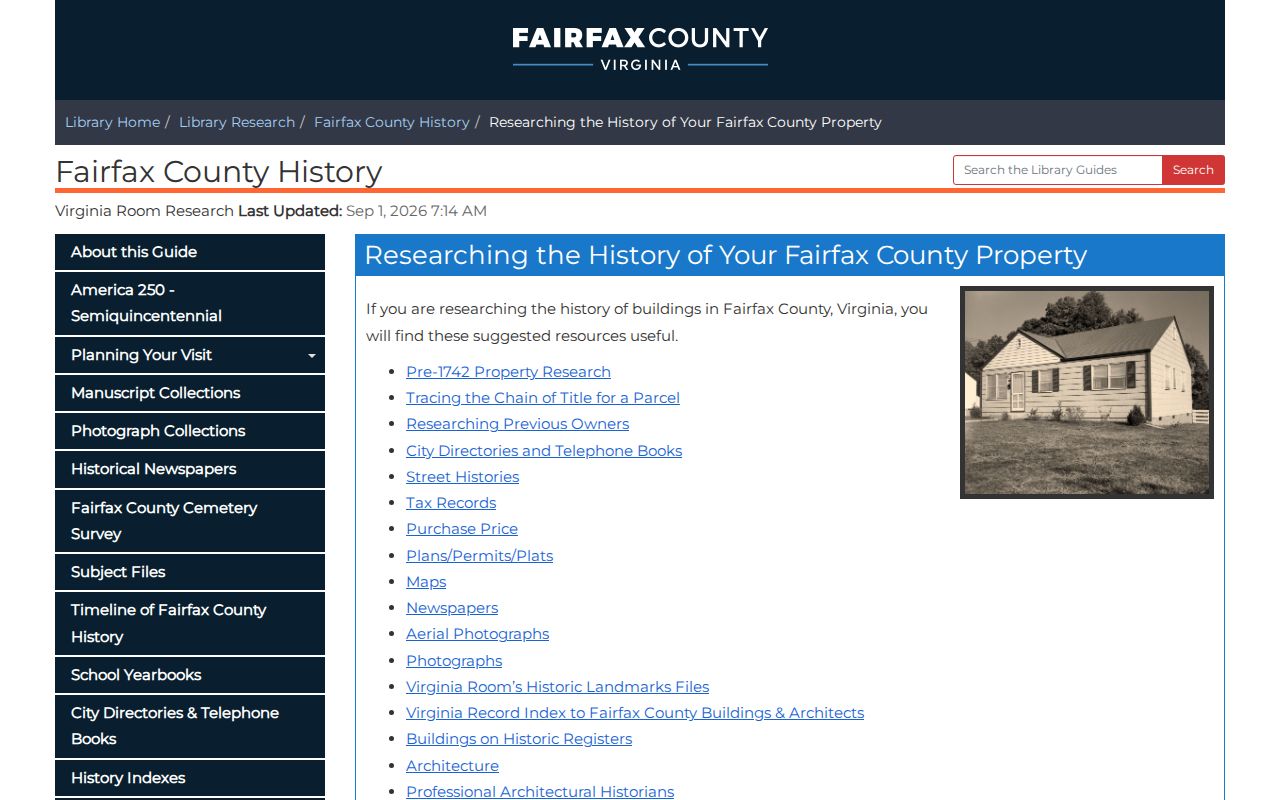
Treat this as a checklist. Then cite the record behind each fact. Fairfax Jade aerial imagery and the Digital Map Viewer can date visible changes to a parcel, but neither tool proves ownership or names past residents of Annandale. Sanborn fire-insurance maps are another matter. Check Sanborn coverage through the Library of Congress catalog rather than assuming sheet years. No official Annandale sheet inventory exists, so do not guess at specific years. The deed remains the anchor.
Pair Annandale Directories With Census
Deeds identify recorded interests, not occupancy. To trace who actually lived in a house, pair the deed chain with household sources. Use volumes from the same years. Fairfax's directory inventory covers 1877, 1878, 1880, 1884, 1888, 1890, 1897, 1906, and 1911. These are county or area volumes, though. A dedicated Annandale book for every year is not guaranteed. Official sources publish no confirmed years for local reverse or criss-cross directories. Ask the Virginia Room or Library of Congress for the right volume. For the collections themselves, start with the Annandale city directory page. A reverse section works from an address to its listed occupants. An alphabetical section confirms a name. Keep one caution in mind. A missing listing proves nothing about an empty property or an absent household member.
- Record the directory’s locality label, title, publisher, year, page, exact spelling, and address before drawing any conclusion.
- Compare the closest available directory years for the first or last appearance, address change, spouse notation, or occupation change.
- Use the 1900, 1910, 1920, 1930, 1940, or 1950 census as a public household anchor, then fill the intervening years with directory and newspaper evidence.
- Test the household dates against the deed, probate, cemetery, or obituary trail, noting whether each source reports ownership, residence, or only an event.
Personal house history only. Previous-resident research can support family history, estate questions, and property curiosity. Do not use historical records to harass, track, or expose any living person.
Annandale Previous-Resident Archive
A name missing from a deed index can still surface in court records. The Fairfax Historic Records Center holdings explain why. Its collections hold original deeds, wills, court minutes, chancery and law papers, marriage material, early vital records, tax records, and other early county business. When you visit, request the specific book, box, or series. Staff do not run an exhaustive keyword search for you.
The HRC is open by appointment. It sits at 4110 Chain Bridge Road, Suite 317, Fairfax, reachable at 703-246-4168. The archive also helps interpret gaps in a record chain. Fairfax History Commission projects made many early court materials easier to use. The work came through indexing and microfiche. Even so, some administrative files were destroyed under a 2008 retention policy. Treat a missing file as a prompt to search related Virginia Room or HRC collections. Do not read it as proof the event never happened.
Annandale Previous-Resident Source Layers
The Library of Congress house-history guide backs the same layered method. Deeds, property taxes, maps, directories, newspapers, and local histories each answer one part of an address question. Each layer covers a different era. In Annandale, iCare and the deed chain build the parcel foundation. Fairfax maps, aerials, directories, and HRC materials then carry the past-residents trail across eras.

Plan around a renovation. George Mason Regional Library is scheduled to close after October 23, 2026. The closure covers roughly two years of construction. During that period, direct directory or property-history work to the Virginia Room at City of Fairfax Regional Library. Confirm any nearby-branch fallback before you travel. The Virginia Room offers a public CPAN station. It also has a microform reader-printer that saves research to USB.